


The Reserve Bank of New Zealand (RBNZ) cut interest rates by 0.25% as expected in their November policy statement but dampened expectations of further easing.
Which Kiwi strategies moved beyond the watchlist stage and how did shifting market sentiment impact the outcomes?
Watchlists are price outlook & strategy discussions supported by both fundamental & technical analysis, a crucial step towards creating a high-quality discretionary trade idea before working on a risk & trade management plan.
If you’d like to follow our “Watchlist” picks right when they are published throughout the week, check out our BabyPips Premium subscribe page to learn more!
We’re breaking down our NZD setups this week and how each pair performed after a less dovish RBNZ decision while markets braced for additional volatility and profit-taking during the Thanksgiving holidays.
The Setup
What We Were Watching: RBNZ Monetary Policy Statement (November 2025)
- Expectation: RBNZ to cut interest rates from 2.50% to 2.25%
- Data outcome: Central bank lowered borrowing costs by 25 basis points as expected
- Market environment surrounding the event: Risk rebound since the beginning of the week, chalking up a significant recovery from the previous week’s equity selloff and priming for profit-taking before the long weekend
Event Outcome
The RBNZ reduced its Official Cash Rate by 25 basis points to 2.25% as the Monetary Policy Committee voted 5-1 in favor of the reduction, with one member preferring to hold rates unchanged at 2.50%.
Key Takeaways:
- RBNZ cut OCR by 25bp to 2.25% in 5-1 vote, with dissenter favoring no change
- Annual CPI at 3.0% in September quarter, but expected to fall to around 2% by mid-2026
- Central projection shows OCR on hold through 2026, with rate track bottoming at 2.20% in Q1 2026
- Economy showing early recovery signs with stabilizing labor market and improving household spending
- Committee signals balanced risks, effectively closing the door on further easing absent a major shock
During the presser, outgoing RBNZ head Christian Hawkesby struck a notably less dovish tone than in previous meetings. He mentioned that the central bank published “a central projection that would be consistent with the official cash rate being on hold through the course of 2026 and one where we feel the risks are balanced.”
Fundamental Bias Triggered: Bullish NZD setups
Broad Market and Exogenous Drivers:
Risk Recovery on Dovish Fed Narrative (Monday-Tuesday): Cautious optimism came into play as the week opened, with higher-yielding assets licking their wounds from the previous week’s bloodbath on fresh dovish Fed commentary. This narrative carried on the following day as delayed U.S. releases painted a mostly grim picture of the economy over the course of the government shutdown.
Risk appetite also drew support from geopolitical developments, as the focus turned to progress in Ukraine-Russia negotiations, with U.S. President Trump boasting that their latest framework trimmed the number of proposals under discussion.
Pre-Thanksgiving Positioning (Wednesday): Risk-on flows were sustained until the middle of the week, as most market players prepped to close their positions ahead of the long weekend in the U.S. and Canada while a mostly downbeat Fed Beige Book still supported December rate cut hopes.
Speculations that Kevin Hassett, current Director of Trump’s National Economic Council, is emerging as the frontrunner for the next Fed Chairperson position also boosted expectations of cheaper borrowing costs.
Thanksgiving Spike (Thursday-Friday): What was expected to be a bit of a liquidity lull over the last couple of days of the week turned out to be a volatility surprise, as a CME technical outage sparked brief market choppiness. Profit-taking also came into play, particularly for U.K. markets in the aftermath of the budget announcement, while Fed rate cut bets picked up.
Reports of Trump urging Japan to soften its stance on China also prompted some risk flows on Thursday, with the Loonie scoring additional gains on an upside Canadian GDP surprise and the Kiwi rallying on better-than-expected retail sales data.
Scenario Scorecard: How Did They Play Out?
NZD/JPY: Bullish Event Outcome + Risk-On Scenario = Arguably good odds of a net positive outcome
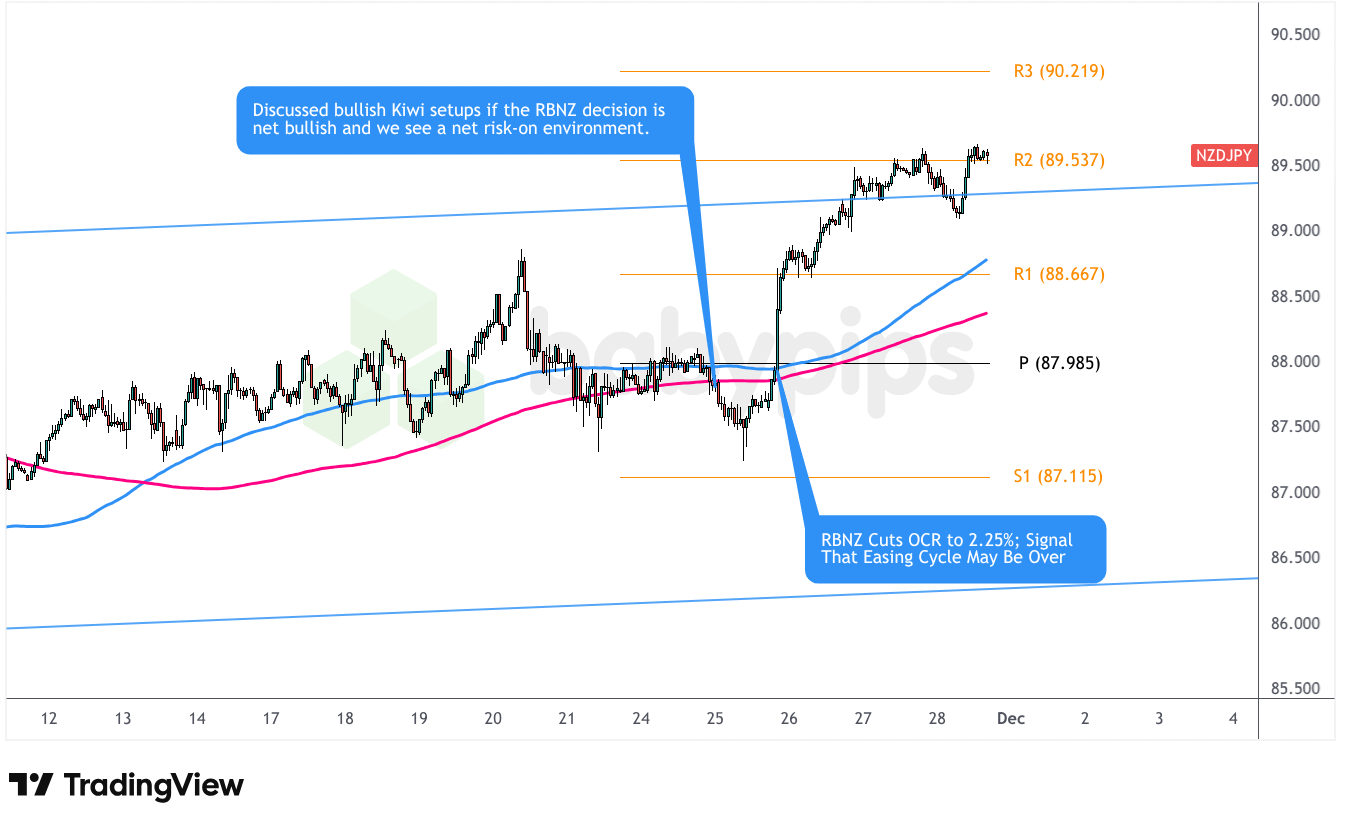
NZD/JPY 1-hour Forex Chart by TradingView
Our analysts looked into an uptrend channel pullback on NZD/JPY, as the pair hovered around the pivot point and mid-channel area of interest early in the week, anticipating a rally back to the resistance and possibly a bullish break in case the RBNZ makes a less dovish decision.
The target event yielded a sharp bullish Kiwi reaction, as the central bank kept its rate reduction limited to 0.25% while also dampening expectations of future easing, fulfilling our “less dovish” requirement for a NZD bullish lean. The broad market was arguably leaning net positive around this time, thanks to rising expectations of lower U.S. borrowing costs and geopolitical developments were mostly positive. All combined, NZD/JPY was arguably the best pair to move on beyond the watchlist stage to additional due diligence, planning and possibly taking on risk exposure.
After the initial reaction spike higher to the event, NZD/JPY moved onto test R1 (88.66) within a few hours after the announcement. The pair sustained its upside momentum in the succeeding trading sessions, arguably lifted by extended risk-taking, eventually testing the R2 Pivot resistance area (89.53) before a bit of Thanksgiving profit-taking came in play, although another bounce back to resistance followed after a retest of the broken channel top as risk themes from earlier in the week remained in play.
Not Eligible to move beyond Watchlist – NZD/CAD & Bearish NZD Setups
NZD/CAD: Bullish Event Outcome + Risk-Off Scenario
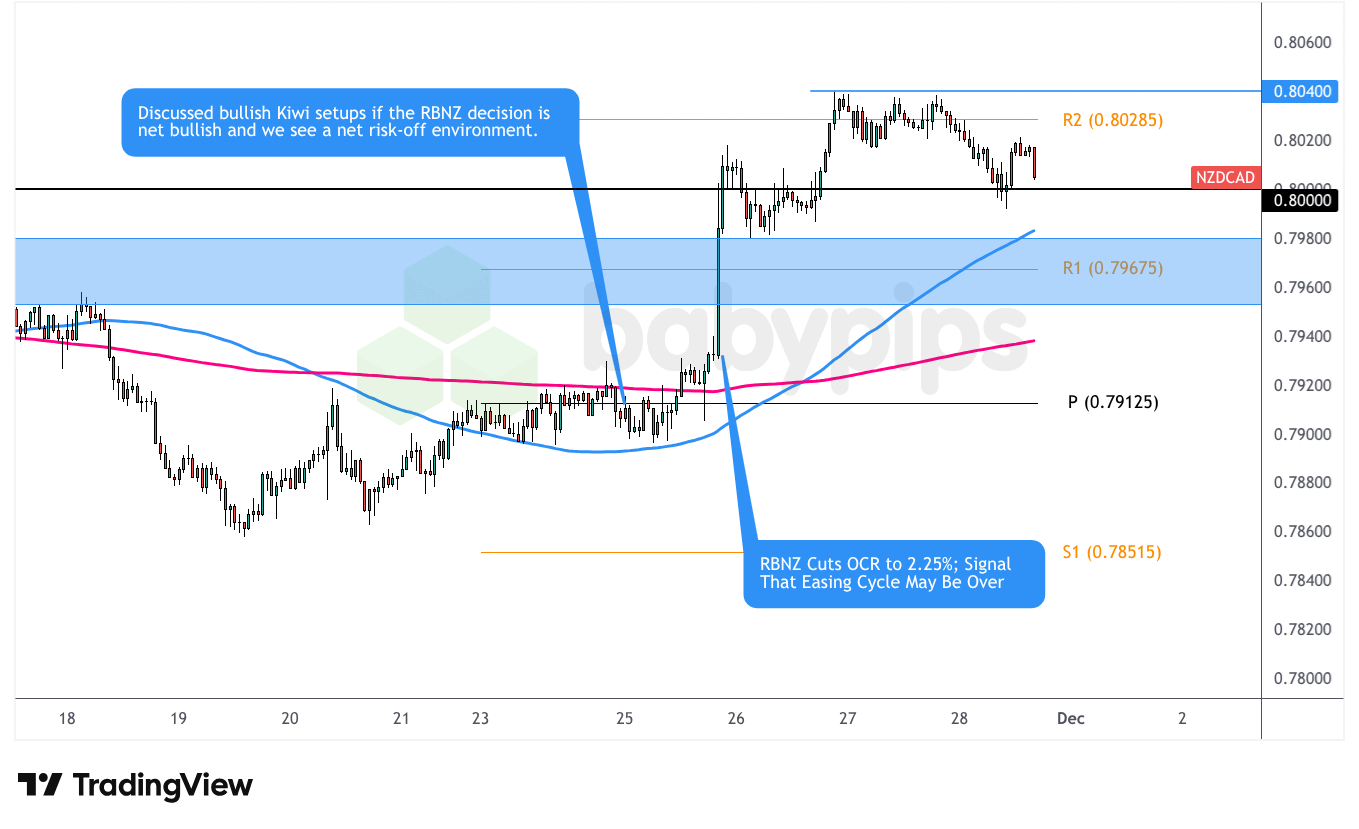
NZD/CAD 1-hour Forex Chart by TradingView
This Kiwi pair had been trading inside a descending channel and was on its way to test the resistance ahead of the RBNZ decision. Our watchlist setup eyed a possible bullish breakout in case the RBNZ sounds more optimistic in a risk-off environment.
Even though the target event turned out NZD bullish, overall market sentiment favored risk-on moves for the most part of the week. The early risk rebound found legs as Russia and Ukraine made progress in peace negotiations while traders continued to price in dovish Fed expectations on account of net downbeat U.S. data and speculations of Hassett possibly being appointed as next Fed Chair. Given that broad market sentiment did not align with our original watchlist discussion, a long bias on NZD/CAD was not eligible to move beyond watchlist stage.
NZD/CAD rallied sharply during the RBNZ announcement, breaking through the R1 (.7967) resistance eyed as entry confirmation and even busting through the key .8000 barrier. Price hovered around this major psychological ceiling for a while in the next trading sessions, as CAD also managed to put up a strong fight in a risk-on setting. The pair gained a bit more traction on its climb to R2 (.8028) but gains were capped at this point when Canada’s upside GDP surprise dragged NZD/CAD back to the .8000 mark on Friday.
NZD/CAD: Bearish Event Outcome + Risk-On Scenario
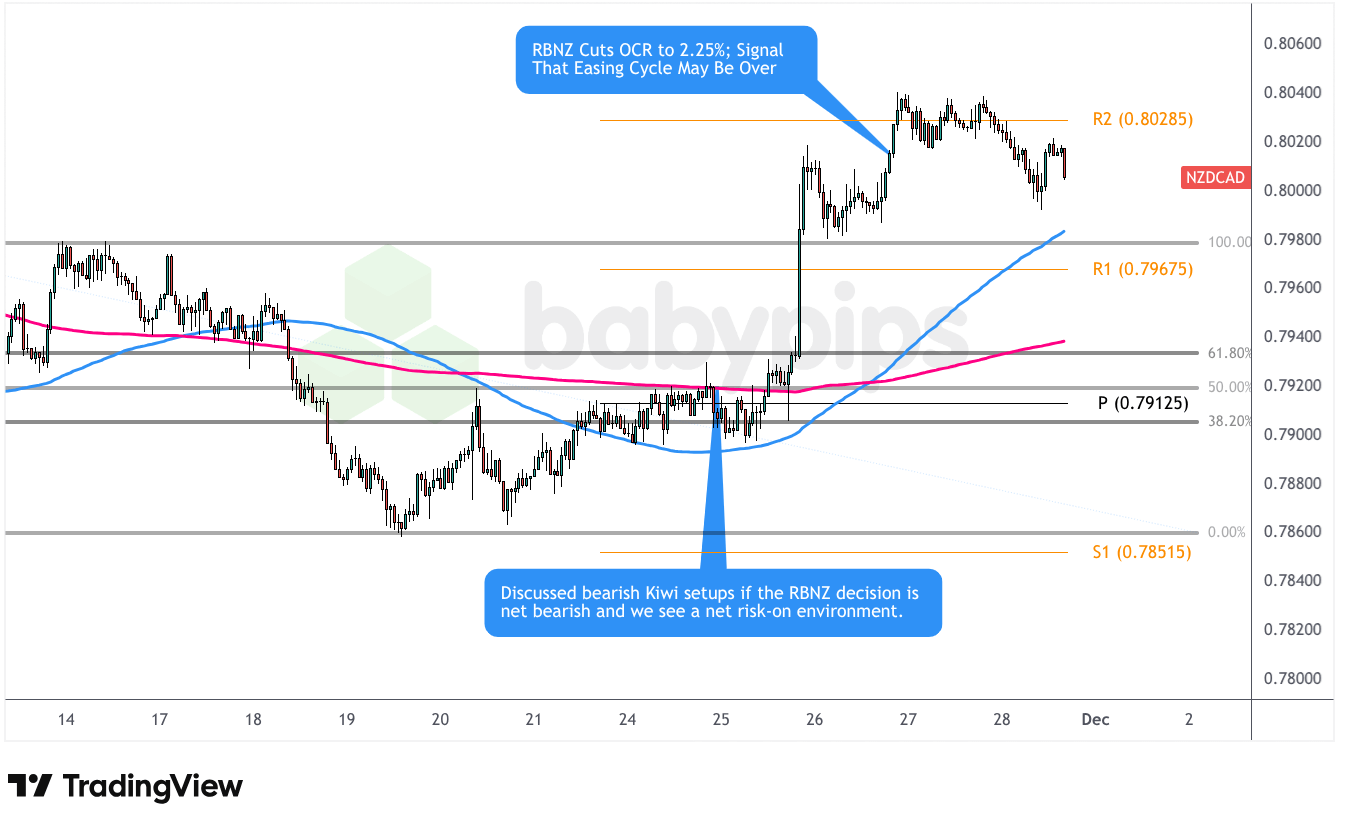
NZD/CAD 1-hour Forex Chart by TradingView
Our analysts at looked at NZD/CAD’s downtrend ahead of the event and kept close tabs on possible trend retracement setups if the RBNZ decision turned out bearish, while Canada’s inflation stayed hot and crude oil demand was supported by a potentially strong U.S. retail sales.
However, both the fundamental and technical short biases were invalidated from moving forward from watchlist stage by RBNZ’s hawkish cut and NZD/CAD popping decisively above the trend line resistance during the release.
The pair showed only a limited pullback below .8000 despite an uptick in oil prices, possibly because New Zealand also printed stronger than expected retail sales and business confidence data, while the long weekend in the U.S. likely capped CAD’s upside even after Canada’s hot GDP and budget data on Friday.
NZD/CAD ended the week just above .8000, almost one hundred pips above its pre-RBNZ levels.
NZD/USD: Bearish Event Outcome + Risk-Off Scenario
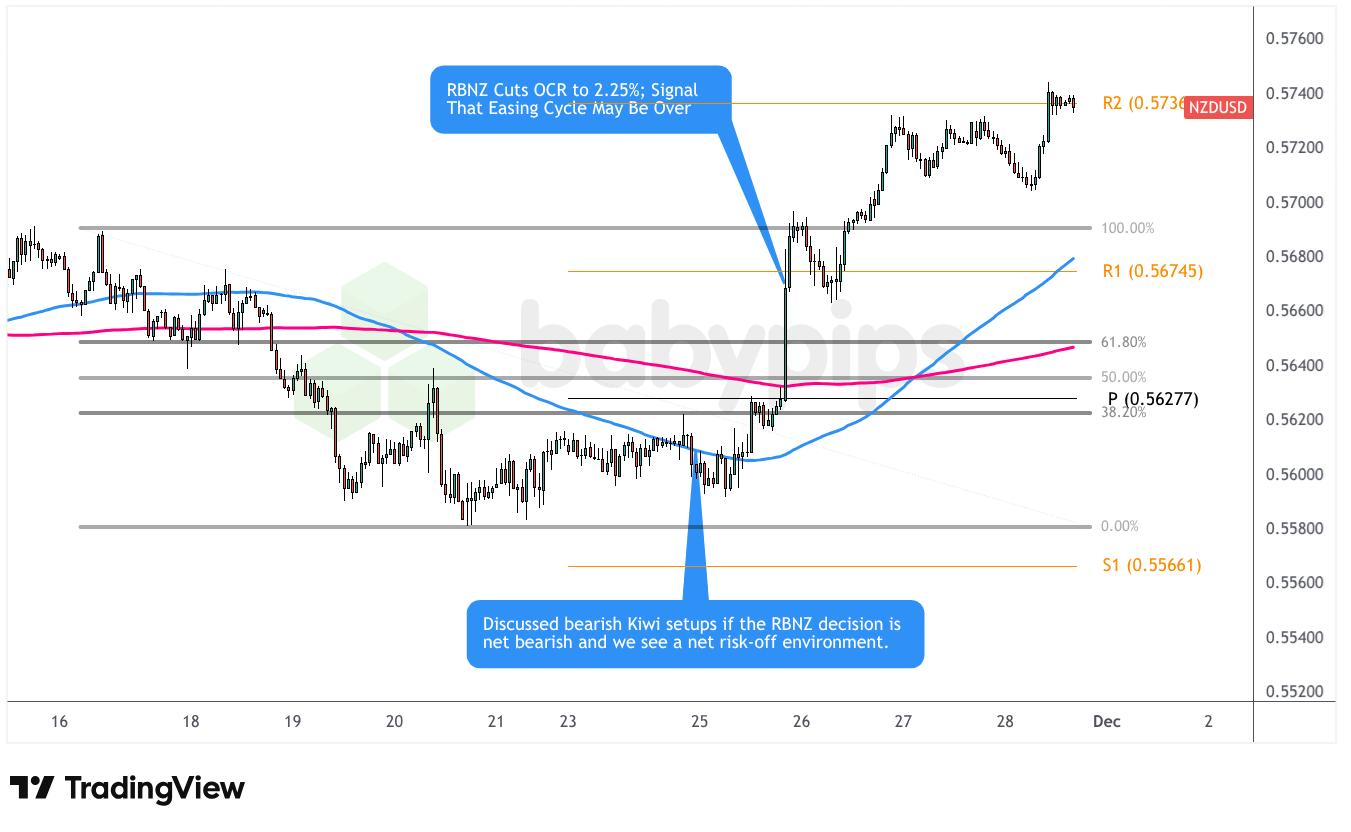
NZD/USD 1-hour Forex Chart by TradingView
Early in the week, our analysts leaned on the rising odds of the Fed keeping rates steady in December and on China-Japan tensions boosting safe haven demand to keep NZD/USD’s downtrend intact if the RBNZ event turned out dovish.
The short fundamental bias started to lose weight once U.S. officials began leaning toward December rate cuts, and the China-Japan tensions failed to escalate. It was fully invalidated when the RBNZ delivered a rate cut that landed on the hawkish side for NZD. NZD/USD also pushed above the identified trend line resistance, which stopped the setup from moving forward from the watchlist stage.
While NZD/USD did see pullbacks, stronger New Zealand data and a lack of fresh catalysts to push back against Fed rate cut expectations kept the pair in demand through the rest of the week. NZD/USD finished above .5700, clearly above the trend line resistance zone.
The Verdict
The less-dovish-than-expected RBNZ announcement and lowered odds of further easing supported bullish Kiwi opportunities, with NZD/JPY emerging as a viable candidate to move beyond the watchlist stage based on the technical setup and overall risk-on environment around the target event.
The pickup in risk appetite early in the week, spurred mostly by resurfacing dovish Fed expectations and supported by geopolitical developments (Russia and Ukraine, then Japan and China), favored upside for the higher-yielding commodity currency and put the safe-haven Japanese yen on the back foot.
Mostly weaker-than-expected U.S. data points and the Fed Beige Book, along with growing speculations of pro-stimulus Kevin Hassett being appointed as the next Fed head, also extended risk-taking ahead of the Thanksgiving holidays. These allowed NZD/JPY to move all the way to the watchlist target levels before the long weekend, even as volatility picked up on tighter liquidity conditions, the CME outage, and profit-taking activity.
Overall, we rate our watchlist discussions as “highly likely” supportive of a potential positive outcome. The risk-on environment lifting higher-yielding commodity currencies, paired with a relatively upbeat RBNZ announcement, led to the anticipated reaction to the event, enabling the technical triggers highlighted in the watchlist setup to play out throughout the week.
Traders who caught on the pair’s mid-channel pullback just before the target event would have caught majority of the move until the swing high and possibly even beyond the channel resistance. Even traders who waited for confirmation after the actual announcement would have still gotten a chance to catch a good chunk of the reaction since NZD/JPY pretty much had a one-way move that carried over to the next trading sessions and days.
Risk management strategies such as trailing stops higher would have proven effective in protecting profits, given how sentiment might have been vulnerable to big swings during the Thanksgiving break.
The week demonstrated how the alignment of fundamental catalysts (less dovish RBNZ announcement) and risk sentiment (dovish Fed expectations, geopolitical improvements) can pave the way for strong one-directional moves and offer multiple opportunities to profit from a top-tier event.
Key Takeaways:
Consider Adding to Positions if Market Themes Are Sustained
This week was a strong demonstration of how reactions to top-tier events can draw extra fuel from prevailing risk themes, especially if developments in the succeeding days continue to support the narrative. In this particular case, dovish Fed expectations were stoked by speculations of Hassett’s appointment, along with downbeat U.S. data and a bleak Fed Beige Book.
Application: Scaling-in strategies could allow one to maximize profit potential on a one-directional move, particularly on breaks above key resistance levels or near-term pullbacks that could offer better return-on-risk, as long as these are also paired with proper risk management techniques like rolling stops higher or adjusting position sizes.
Holiday liquidity considerations matter
The Thanksgiving holiday period created opportunities for profit-taking and increased volatility on thinner trading volumes, making trailing stops and flexible position management crucial even when the fundamental bias remained intact.
Application: Even with a solid directional bias, thin liquidity can spark surprise volatility, so holiday weeks call for more conservative trade management and careful timing of entries and exits. Consider scaling back risk around major holidays by tightening stops, trimming position sizes, or taking partial profits ahead of extended closures.
Disclaimer: The forex analysis content provided in Babypips.com is intended solely for informational purposes only. The technical and fundamental scenarios discussed are presented to highlight and educate on how to spot potential market opportunities that may warrant further independent research and due diligence. This content shows how we cover a portion of the full trading process, and does not constitute that we ever give specific investment or trading advice. The setups and analyses presented on Babypips.com are very likely not suitable for all portfolios or trading styles.
Trade and risk management are the sole responsibility of each individual trader. All trading decisions and their subsequent outcomes are the exclusive responsibility of the individual making them. Please trade responsibly.
Trading responsibly means knowing as much as you can about a market before you think about taking on risk, and if you think this kind of content can help you with that, check out our BabyPips Premium subscribe page to learn more!