


This article has been translated from English to Gen Z Slang.
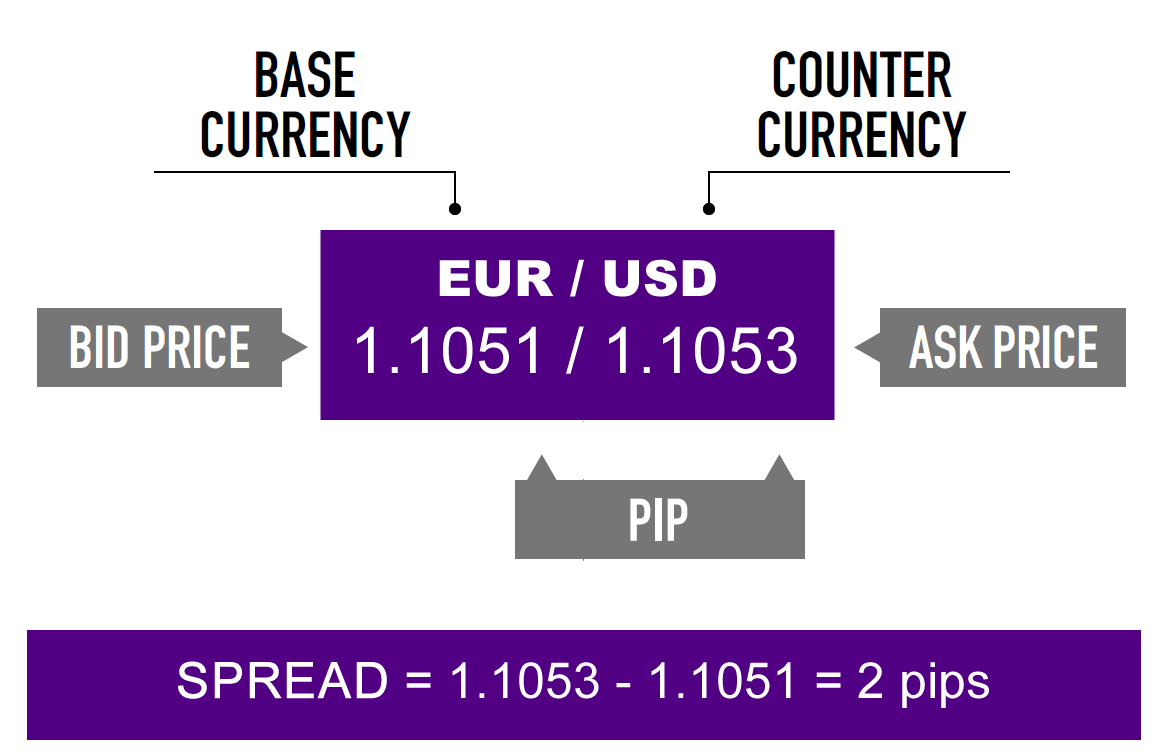
Forex homies be giving you two prices for currency pairs: the bid and ask price.
- The “bid” is where you SELL the base currency at.
- The “ask” is where you BUY the base currency at.
The gap between these prices is the spread.
Also known as the bid/ask spread.

No commission brokers say they're free, but they make bank with that spread.
This is your fee for that instant transaction. So “transaction cost” and “bid-ask spread” are like the same vibes.
Instead of charging a separate price for trading, they sneak the fee into the buy and sell price of the pair you're lookin' to trade.
From a biz POV, this checks out. The broker’s gotta hustle too.
- They get cash by selling it to you for more than they bought it.
- And they cash in by buying it from you for less than when they sell it.
- That, my dudes, is the spread.
It's just like trying to ditch your crusty old iPhone at a tech shop. (Seriously, only two cameras? Ew.)

To cop a profit, they gotta buy your phone at a lower price than they plan to sell it.
If they can flip the iPhone for a cool $1000, they’ll probs not offer more than $999 for it.
That $1 gap? That’s the spread.
So when brokers shout “zero commissions” or “no commission”, don’t be bamboozled. ✨You still paying✨, it’s just sneakily woven into that bid/ask spread!
How is the spread in forex trading measured?
The spread be usually measured in pips, the tiniest vibe of price changing in currency pairs.
Most pairs got one pip equaling 0.0001.
A 2 pip spread for EUR/USD may look like 1.1051/1.1053.
Deals involving the yen show only two decimals (unless fractional pips, then it’s got 3).
Like, USD/JPY may look like 110.00/110.04, showing a spread of 4 pips.
What types of spreads are in forex?
The type of spreads you'll peep in your trading app depends on your forex plug and how they’re hustling.
Two types of spreads:
- Fixed
- Variable (or “floating” if you fancy)

Fixed spreads usually pop up in brokers working as market makers or “dealing desk” operators while variable spreads come from the ones on “non-dealing desk” vibes.
Choosing between fixed and variable depends on your trading edge, risk vibes, and game know-how. Knowing each type’s deets is key.
What are fixed spreads in forex?
Fixed spreads ain’t playin’. They stay solid whether the market is as chill as Billie Eilish or hype like crypto memes during trading sessions.
Fixed spreads are brought by brokers working as market makers or “desk handlers”.Desk handlers scoop up big positions from their big-league money pals and dish ‘em out in nifty sizes to traders.
This way, the dealer ain’t just a provider – they’re the other side of your exchange.
With their own desk handlers, Forex besties can slap on fixed spreads 'cause they control their price forecasts.
What are the advantages of trading with fixed spreads?
Fixed spreads = smaller cash vibes. Ideal for fam with skinny wallets or minimal trading accounts to get in the game cheap.
Trading with these sagittarius spreads also makes paying your trade bill crystal clear.
Since the price don't change, you're always clued into what you're coughing up during trades.
What are the Disadvantages of Trading With Fixed Spreads?
Requotes might pop up a lot with fixed spreads since you’re just rolling with your broker for prices.
And by a lot, we mean like… non-stop Kardashian selfies out here!
If the market’s extra choppy, your bid might get blocked, leaving you with a re-quoted upgraded price that’s whack and usually worse.Your platform may pop that “requote” note letting you know prices switched up, asking you to cosign new price tags.
Slippage is another buzzkill. Fast market? Your desired price ghosted and welcome to new vibes.
Slippage feels like when scrolling through Tinder and that hottie’s profile pic was all lies IRL.
What are variable spreads in forex?
"Variable" hints the game – these spreads vibe-change continually. So bid/ask price differences will dance to the beat.
Brokers with no desks get real-time stuff from various money peeps and spoon-feed you prices, hands-free style.No control over the spread, it flows: widening or slimming with whatever Forex drama dives in.
Typical fat spread antics during economic gossip or when market traffic drops (aka when holidays/COVID hit).
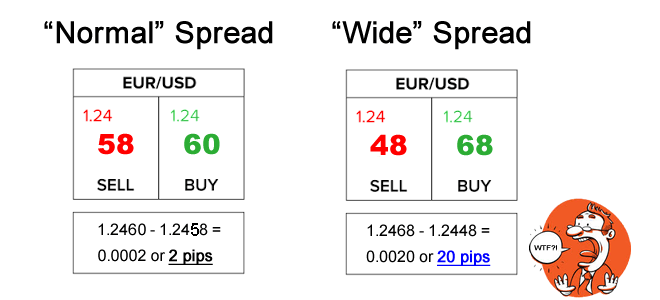
Like, wanna grab some EURUSD at a 2 pip spread, but BOOM! U.S. jobs report hits. Suddenly spread is 20 pips!
And spreads might spike if our frenetic Twitter finger, ex-prez Trump hits the keyboard.

What are the advantages of trading with variable spreads?
Variable spreads save you from the requote plague. It's becoming clear with price flavors matching market beats.
(Lowkey though, just ‘cause there’s no requotes doesn’t mean dodging all slippage!)
Trading forex with variable spreads gives more openness on prices, thanks to various money crew bids, better for ya due to competition.
What are the Disadvantages of Trading With Variable Spreads?
Variable spreads are supes cringe-worthy for scalpers. Puffin' spreads can gobble profits pronto.
Variable spreads bring heartache for newshawk bros. A sweet trade might go sour-spread with a blink-of-an-eye thicc bump.
Fixed vs Variable Spreads: Which is Better?
Which squad to squad up with? Fixed or variable spreads hangouts boils down to traders' needs.
Some think fixed spreads are the jam, while others firmly ride the variable wave vibe.As a broad rule, small-money traders with station-like trading frequency can hang with fixed pricing setups.
And heavy-money pals, trading all the time during peak market hypes (tight spread szn), reap the variable spread uplive.
Traders hunting quick moves while dodging requotes, variable spreads may be the new MO.
Spread Costs and Calculations
After you’ve caught spread knowledge, and ID’d the types, don't bounce without checking this...
How spreads translate into trade transaction bills.
EZ calc to grind through needing only:
- Cost per pip
- The trade size in lots
Peep this learned example...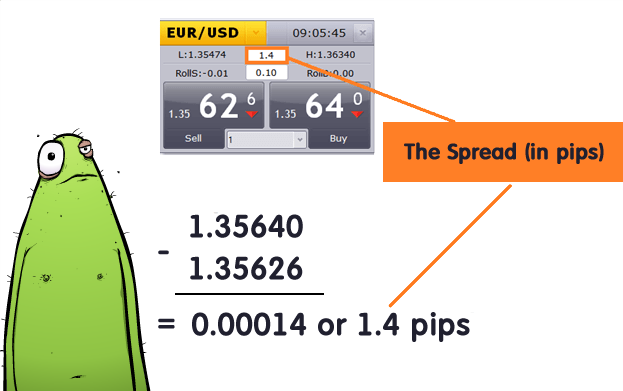
You cop EURUSD at 1.35640 asking 1.35626.
Buying right then and swiping out solid translates to a 1.4 pip hit.
To tag the tally, you calc cost per pip hopped by lots scooped.
For mini-lot rolls (10k units), each pip rings in a dollar, making your transaction tally $1.40 to play that track.

Pip cost = battery infinite. Which means pip cost x lot numbers = trading dollars.
Bigger stake? Bill up as it's inline with the up'd spread notice.
For example, at 1.4 pips and you'd dancing with 5 cool mini lots, transaction fees tally $7.00.
