


This article has been translated from English to Gen Z Slang.
Just like your average support and resistance levels, pivot point levels ain’t gonna last forever, fam.
Using pivot points for range trading is kinda lit, but not every day’s a banger. When these levels ghost you, make sure you’ve got some tools in your forex kit to flex on the situation!
As we dropped earlier, there are two main ways to trade breakouts: the aggressive way or the safe way.Both methods got you covered. Just keep in mind, if you go the safe route and wait for a retest of support or resistance, you might miss out on that initial move, no cap.
Using Pivot Points to Trade Potential Breakouts
Peep this chart to scope out potential breakout moves using pivot points. Below’s a 15-minute chart of EUR/USD.

Here we see EUR/USD was on a mad rally all day long.
We notice that EUR/USD started by gapping up over the pivot point. Price was vibing up, then chilled a bit at R1.Eventually, resistance dipped, and the pair yeeted up by 50 pips!
If you rolled with the aggressive method, you’d be hyped like you just snagged a W at the World Cup.
But if you played it safe and waited for a retest, you’d be feeling all kinds of salty. No retest happened after breaking R1. Real talk, same vibes at both R1 and R2!
Check how EUR/USD bulls tried to yeet towards R3 too.
Heads up though, if you went aggressive, the fakeout might’ve clapped you as the price didn’t stick the landing. If your stop was tight, you’d get stopped out real quick.
Later on though, you’ll see the price finally breaks through. Peep how there was a retest of that busted resistance line too.
Also, check when the pair flipped later in the day and dipped past R3. There was a chance to short it on the retest of resistance-turned-support-turned-resistance (for real, read that again if needed!).
“Role Reversal”
Remember that, when support levels get wrecked, they usually turn into resistance levels.
This idea of “role reversal” also hits with broken resistance levels that turn into support levels. These would’ve been sweet chances to go with the “I think I’ll play it safe” vibe.
Where do you place stops and pick targets with breakouts?
Picking a spot for your stop in breakout trades can be hella tricky.
Unlike range trading where you’re peeping for breaks of pivot point support and resistance levels, you’re hunting for strong, fast moves.
Once a level’s toast, theoretically, that level’s probably now “support-turned-resistance” or “resistance-turned-support.” Again, this is a role reversal...’cause the roles flipped.
If you were holding long and the price busted R1, you could place your stop just below R1.
Let’s bounce back to that EUR/USD chart to see where you could drop your stops.
When setting targets, you’d usually aim for the next pivot point support or resistance level as your take profit spot.
It’s a rare flex for price to break past all the pivot point levels unless there’s a massive economic event or some surprise tea gets spilled.
Let’s bounce back to that EUR/USD chart to see where you’d set those stops and snag profit.
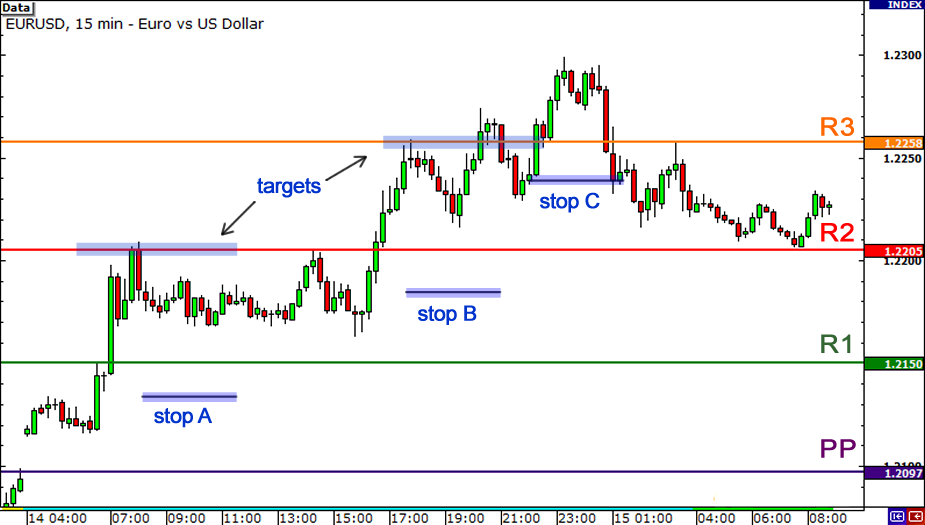
In this example, after the price broke R1, you’d have set your stop just below R1.
If you thought the price would keep rising, you could hold your position and finesse your stop manually to see if the move would keep going.You’d need to keep your eyes peeled and make moves accordingly. More on this in future lessons.
As with any method or indicator, always stay woke to the risks of breakout trades.
First up, you can’t be sure if the move will pop off. You might dip in thinking it’s going up, but instead, you catch a top or bottom, aka you got faked out!
Second, you won’t know if it’s a legit breakout or just wild stunts from some juicy news dropping.
Volatility spikes hit different during news events, so stay in the loop with breaking news and what’s on the economic calendar for the day/week.
Lastly, like in range trading, best to pop on other key support and resistance levels too.You might think R1 is breaking, but slept on a strong resistance level just past R1.
Price could break past R1, test the resistance, and then yeet back down.
Make use of your forex smarts on support and resistance, candlestick patterns, and momentum indicators to help you confirm if the break’s for real or not.