


This article has been translated from English to Gen Z Slang.
Yo, how lit is your broker's order execution?
Order execution is basically how your buy or sell orders get handled, no cap.
So, in the previous lesson, we dished on the prices forex brokers drop on their platforms and whether they're straight-up or bogus.
But real talk, even if your platform's prices are on fleek, it's straight-up trash if your trade never lands at that vibe.
It's like you hit up a bakery, peep a cake pic that’s fire, and order it—only to find out the baker totally ghosted on making the actual cake.

Peep that image? It's a total example of a bakery botching a cake order, lol.
You gotta find a baker broker that's all about top-tier execution quality and mad transparency.
In short, your broker should always be on point in treating you right when executing your orders.
Let's throw it back to that story with Batman and Spider-Man:
Betting it’s gonna go up from 1.4100, that’s the current drip. Here’s my $20 to get the bet poppin'.
Then Spider-Man’s like, “Yo, my spidey senses say GBP/USD is gonna keep climbing,” so he straight-up pretends he didn't peep Batman.
Yo, you hear me? Unlike snakes, spiders ain't deaf. Here’s another $20 to open this bet.
Huh, what was that? So you’re actually in? My price for GBP/USD just flipped to 1.4150. Still down for it?
Bro, what the heck? I thought you said GBP/USD was 1.4100. Now you flipping the price outta nowhere?
That’s the new price. You in? Hurry up before I flip it again!
Aight, I'm in. Bet it's gonna pop off from 1.4150.
Peep that: Spider-Man first was gonna fill Batman’s order at 1.4100, but then flipped it to 1.4150.
Batman got jacked by 50 pips. That’s totally sus.
If you ain't in on that story above, it means you missed our earlier lesson on How Forex Brokers (Kinda) Work. Do yourself a solid and peep it first.
What's your broker's Order Execution Policy, fam?
Forex brokers gotta drop clear disclosure on how they execute your orders.
They should have a doc, usually dubbed "Order Execution Policy", on deck.
This doc breaks down how their trading platform executes your orders to hook you up with the best possible result.
Having a clear order execution policy, so you know how your orders gonna be handled, is a must before you even vibe with a broker.
You should peep these:
- How they choose their price sources, no cap.
- How they pick their hedging counterparty (the LPs) for your trades.
- How they pick and keep an eye on the tech they use for order exec.
- How they handle any potential or real conflicts of interest when execing your orders.
Once you peep and get their policy, there's more homework on deck!
Peep these Q's to ask your broker to scope out their order execution game:
- How serious is the broker about order execution quality and transparency?
- How much of their order exec is automated?
- What's the average spread per currency pair?
- How speedy are trades? What’s the average exec speed?
- What % of orders get hit with slippage?
- What % of trades actually get filled?
- What % of orders score positive slippage?
- What % of orders get hit with negative slippage?
How committed is the broker to keeping it 100 with order execution quality and transparency?
Brokers who are all about fair pricing and dope order execution prove it by being transparent and publicly disclosing execution stats.

These brokers drop exec data reports on the regular, featuring deets like average exec speed, spreads, % of trades filled at the requested price (no slippage), and the breakdown of positive and negative slippage.
These reports are usually posted on the broker's site. If you can't spot them, hit up the broker and ask for it.
Aside from exec reports, how transparent are they about their order process? Do they spill the following:
- Who are their liquidity providers (LPs)?
- What % of volume does each LP drop?
- Do they spill any tea on close links, conflicts of interest, or shared ownership with LPs?
- Do they break down any deals with LPs about payments, discounts, rebates, or other perks?
- Do they explain how order execution vibes differ for different customers, like if they play favorites?
If they can't drop that info or say it's not public, you might wanna bounce and find a broker that's more on board with transparency and fairness in the forex game.
How automated is the order exec process?
There are some shady brokers out there who mess with order exec conditions to favor themselves.
Can your broker break down how they handle order execution?
Is the whole process automated? If not, can they break down when manual intervention kicks in?
What's the average spread per currency pair?
On the platform, the broker drops two prices:
- The higher price (“ask”), where you can BUY (go long).
- The lower price (“bid”), where you can SELL (go short).
Together, those are the broker’s prices.
The diff between the bid and ask is the spread.
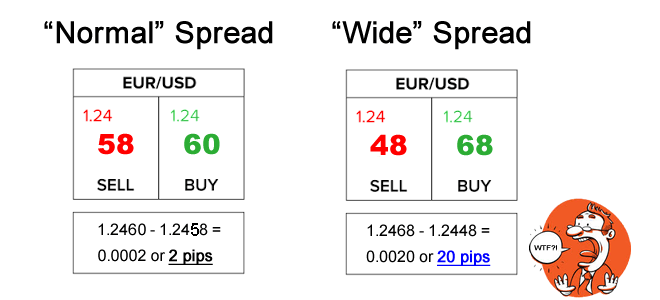
So, what's the average spread per currency pair that the broker hooks you up with?
Can the spread data be broken down by hours? For example:
- What's the average spread during ALL trading hours?
- What's the average spread during PEAK hours?
- What's the average spread during NON-PEAK hours?
How fast are trades executed?
How quick are trades getting filled? That’s what we call execution speed.
Execution speed is basically the time gap from when the broker gets your order until it goes through.

The faster the speed, the more trading can go down. Plus, the quicker it is, the better chance you have to snag the price you want.
Ask your broker about their average exec speed. Ideally, it should be 0.1 second (or 100 ms) or less.
Also, ask what % of trades get executed in less than 1 second.
If orders take more than 1 second, you're probably gonna catch slippage since prices shift quick.
Forex prices can flip in milliseconds, so if the broker's speed is too slow, the price you tapped might've changed by the time they execute your order.
What % of orders get executed with slippage?
When you peep a price on your broker’s platform and wanna trade at that price, your broker’s supposed to hustle to fill your order at that requested price.
When executing orders, the broker’s gotta do everything to hook you up with the best possible result—that’s what we call chasing "best execution".
Ideally, that means you snag the price you requested.
But even though price is the key factor in best execution, it's not the only vibe.
This means the price you wanted might not be the one your order actually gets.
When you get filled at a different price than what you requested, that’s called "slippage".

Traders usually focus on the spread and mostly ghost slippage, unless it’s super obvious when an order gets filled.
Slippage isn’t always a bad thing, since any diff between the intended price and the executed price is considered slippage.
Market prices flip quick, so slippage can happen during the delay between your order being processed and when it goes through.
Slippage can happen for many reasons, but price volatility is usually the main culprit.
When price volatility spikes, slippage (both positive and negative) goes off more often. When it chills, slippage is way less frequent.
That’s why you see more slippage during high volatility moments, like breaking news, economic drops, or when that ex-prez used to drop random tweets.
Under chill market conditions, if your broker’s on point with execution quality, slippage should be rare and minimal.
What % of trades get successfully executed?
A successful order is when it's filled at the requested price or better.

This can be split further into market and limit orders:
- What % of market orders get filled “at or better”?
- What % of limit orders get filled “at or better”?
Once your order goes through, it’s called "filled" or a "filled order".
Market and limit orders can be used as entry orders (to open a new position) and closing orders (to shut a position).
A market order is basically an instruction for your broker to execute a trade immediately at the best available price.
A limit order is an instruction to execute a trade at a price that's even more favorable than the current market price.
Limit orders let you set the minimum sell price or the maximum buy price.
What % of orders get executed with positive slippage?
Positive slippage, also called price improvement, happens when your order gets filled at a better price than you requested.
(The flip side, negative slippage, is when your order gets filled at a worse price.)
Can the broker spill the tea on what % of trades got executed at a more favorable price than requested?
And what’s the average positive price improvement per order (in pips)?
That’s just the pip difference between the requested and executed price for orders with the better price.
Orders can also be split into market and limit orders:
- What % of market orders get filled at a better price than requested?
- What % of limit orders get filled at a better price than requested?
For instance, say you wanna buy EUR/USD right now.
You log onto your broker's trading platform, see the price of 1.1050, and hit “Buy”.

So 1.1050 is the price you wanted your market order to hit.
The order goes through, and you get confirmation that your buy order was filled at 1.1049 (1 pip better than your requested price).
Since it got filled at a better price (1.1049) than you requested (1.1050), you scored a positive slippage of 1 pip.
What % of orders get executed with negative slippage?
Negative slippage is when your order gets filled at a less favorable price.
Some shady brokers got software that low-key slips you a few pips on every trade—like death by a thousand cuts—so you might not even notice. That's why you ask about their negative slippage stats.
Can the broker spill the % of trades that got executed at a less favorable price than requested?
And what’s the average negative price hit per order (in pips)?
That’s just the pip diff between the requested and the executed price for orders that got hit with a worse price.
This can be broken down further for market, limit, and stop orders:
- What % of market orders get filled at a worse price than requested?
- What % of limit orders get filled at a worse price than requested?
- What % of stop orders get filled at a worse price than requested?
For example, say you’re trying to buy EUR/USD at 1.1270.
So on your platform, you drop a limit order at 1.1270 and hit “Buy”.

So 1.1270 is the price you wanted your limit order to hit.
After a few minutes, you get confirmation that your buy order was filled at 1.1273 (3 pips worse than your requested price).
Since it got filled at a worse price (1.1273) than requested (1.1270), you got hit with a negative slippage of 3 pips.
If you're peeping your spread and slippage, it's usually when you open a trade—then you totally forget to check when you close. Shady brokers know you're watching when you open, so they chill, but when you close, they sneak in extra slippage. 👿
You feelin' sus about why your order didn’t hit the requested price?
Brokers might have the power on their platform to control and add slippage or delay your order, so you end up getting filled at a whack price.
For example, brokers can purposely add negative slippage during execution if the price benefits them.
But if the price doesn’t benefit them, they slip it and re-quote with a price that favors the broker.
If you're feeling sus about why your order didn’t hit the requested price, you can ask for a post-trade execution report.
When you ask, your broker should hook you up, within a reasonable time, with documented proof that they executed your order according to their Order Execution Policy, along with info on their execution setup.
For example, in the U.S., retail forex brokers are required to provide customers, on request, with certain order execution data.
This includes price data for the 15 transactions in the same currency pair that happened immediately before and after your trade, so you can check that the offered prices vibe with the real market.
The Lowdown
Forex brokers roll with different order execution methods, and none of 'em are inherently right or wrong.
What makes a broker good isn’t about A-Book or B-Book—it’s all about how they run their biz.
Don’t assume that dropping "A-Book", "STP" or "ECN" means the broker is dope.
An A-Book broker can still play you just as bad as a B-Book broker.
Any broker can hold your deposits, serve whack pricing, manipulate order execution, and lie to you.
No matter the execution method, what really matters is that the broker:
- Provides transparent prices that closely track the real (institutional) FX market in real-time and
- Fills orders at your requested prices, fast.
You wanna roll with a broker who:
- Is straight-up about the risks of leveraged trading
- Keeps it real about their pricing policy
- Breaks down clearly how they execute orders
- Processes withdrawals on the quick
- Has solid risk management policies
- Is well-capitalized (so they don't go bust)
- Has a legit process for handling customer complaints that's quick and fair
- Is licensed and regulated in multiple jurisdictions (especially where you live)
If a broker isn’t clear about all this on their site, hit them up directly and ask.
If your broker dodges your questions, ask WHY. 😑
Be extra sus of any broker who thinks they're untouchable.
Always check out how a broker really operates BEFORE dropping real cash and opening live trades.