


This article has been translated from English to Gen Z Slang.
What's the tea on pivot points?
The trading pros and market playas use pivot points to peep potential support and resistance spots.
In plain English, a pivot point and its support/resistance levels are zones where price vibes might switch up.
Why are pivot points such a big mood?‘Cause they’re STRAIGHT FACTS.
Unlike those other indicators we’ve schooled you on, there's zero guesswork.
Lowkey, forex pivot points are kinda like Fibonacci levels. So many peeps eyeball those levels, they basically manifest themselves.
The major diff is that with Fibonacci, you gotta make some calls on picking Swing Highs and Lows.With pivot points, forex traders usually stick to the same formula to calculate them.
Many traders are all about these levels and you should be, too.
Pivot points are a whole vibe for short-term traders looking to snag small price moves.
Just like your typical support and resistance levels, forex traders can choose to trade the bounce or the break of these levels.
Range-bound traders use pivot points to spot where the party might flip. They see pivot points as zones for their buy or sell moves.
Breakout forex traders use pivot points to peep key levels that gotta be smashed for a move to be legit classified as a breakout.
Check this example of EUR/USD pivot points on a 1-hour chart:
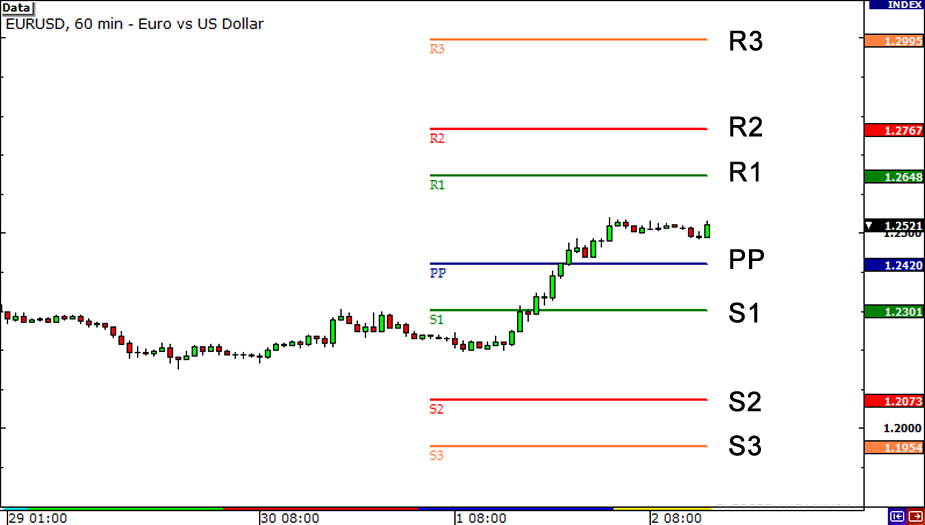
See those horizontal support and resistance levels on your chart?
And look...they're all laid out for you! How clutch is that?!
Pivot Point Lingo
Here’s the lowdown on those acronyms:
PP is your Pivot Point.
S is for Support.
R is for Resistance.
But don't get it twisted thinking “S1 is always support!” or “R1 is always resistance.”
We’ll spill the deets later.
In the next lessons, you’ll learn how to work out forex pivot points, the different types of pivot points, and most importantly, how you can level up your forex trading with pivot points!