


An Exponential Moving Average (EMA) is a type of moving average that gives greater weight to the most recent price data, making it more responsive to new information compared to a Simple Moving Average (SMA), which weights all data points equally.
As we mentioned in the previous lesson, simple moving averages can be distorted by spikes. We’ll start with an example.
Let’s say we plot a 5-period SMA on the daily chart of EUR/USD.
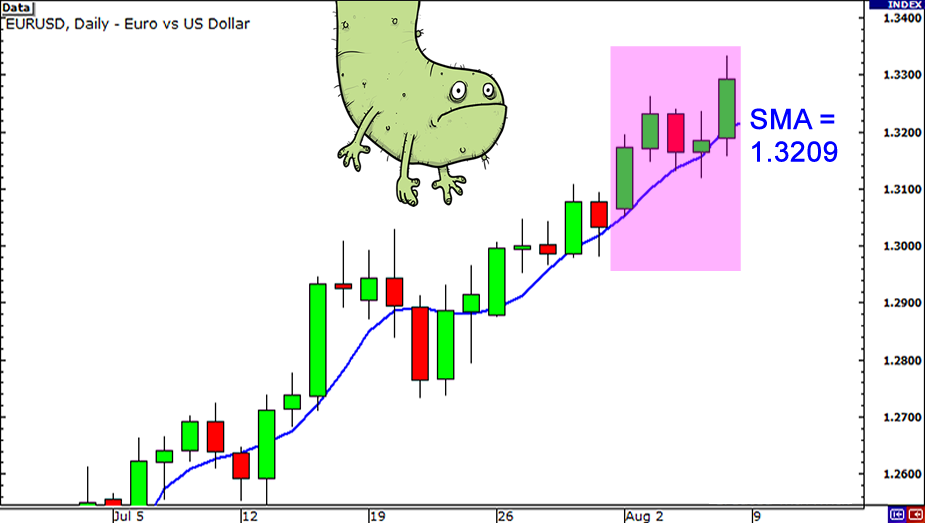
The closing prices for the last 5 days are as follows:
Day 1: 1.3172
Day 2: 1.3231
Day 3: 1.3164
Day 4: 1.3186
Day 5: 1.3293
The simple moving average would be calculated as follows:
(1.3172 + 1.3231 + 1.3164 + 1.3186 + 1.3293) / 5 = 1.3209
Simple enough, right?
Well, what if there was a news report on Day 2 that caused the euro to drop across the board?This causes EUR/USD to plunge and close at 1.3000. Let’s see what effect this would have on the 5-period SMA.
Day 1: 1.3172
Day 2: 1.3000
Day 3: 1.3164
Day 4: 1.3186
Day 5: 1.3293
The simple moving average would be calculated as follows:
(1.3172 + 1.3000 + 1.3164 + 1.3186 + 1.3293) / 5 = 1.3163
The result of the simple moving average would be a lot lower, and it would give you the notion that the price was actually going down when, in reality, Day 2 was just a one-time event caused by the poor results of an economic report.
The point we’re trying to make is that sometimes the simple moving average might be too simple.If only there were a way that you could filter out these spikes so that you wouldn’t get the wrong idea.
Hmm… Wait a minute… Yep, there is a way!
It’s called the Exponential Moving Average!
Exponential moving averages (EMA) give more weight to the most recent periods.
In our example above, the EMA would put more weight on the prices of the most recent days, which would be Days 3, 4, and 5.The EMA calculation assigns greater weight to the most recent prices, while the influence of older prices, including any large spikes, is reduced exponentially as time passes.
This means that the spike on Day 2, its impact on the current EMA value is minimal, allowing the EMA to reflect current market conditions more accurately and respond more quickly to recent price changes.
In contrast, the SMA gives equal weight to all prices in the selected period, so a large price spike from the past continues to influence the average until it drops out of the calculation window.
This makes the SMA slower to adjust to recent changes and more susceptible to being skewed by older, outlier price movements.
As a result, the EMA is generally more effective at minimizing the lingering effect of past price spikes and providing a more current view of price trends.
Exponential Moving Average (EMA) vs. Simple Moving Average (SMA)
Let’s take a look at the 4-hour chart of USD/JPY to highlight how a simple moving average (SMA) and exponential moving average (EMA) would look side by side on a chart.

Notice how the red line (the 30 EMA) seems to be a closer price than the blue line (the 30 SMA).
This means that it more accurately represents recent price action. You can probably guess why this happens.
It’s because the exponential moving average places more emphasis on what has been happening lately.
When trading, it is far more important to see what traders are doing NOW rather than what they were doing last week or last month.